
Babolat Pure Aero vs Pure Drive:
Which Should You Choose?
We hope you love this article. Just so you know, TennisCompanion may collect a small share of sales from the links on this page to help keep this site running. Learn more.



The Babolat Pure Aero and Pure Drive have long been two of the most recognizable modern performance frames on the market. They’re frequently cross-shopped and often recommended to similar types of players, largely because they share a similar profile. With matching head sizes, similar weight and balance, and a reputation for easy power, it’s not always clear where one truly separates from the other.
That similarity holds up until you spend extended time hitting with them. While they occupy the same general category, the way each racquet delivers its performance begins to feel distinct as points develop and swing speeds increase. Those differences aren’t always immediately apparent, but they’re consistent enough to influence key performance attributes and how you construct points over time.
In this comparison, I tested the latest standard 100-inch versions of both frames with identical string setups, focusing on how each racquet behaves side-by-side. The goal is to clarify how these two frames differ in feel, response, and intent, and which type of player is more likely to benefit from each, to help you make an informed decision.
| Popular Retailers | Pure Aero | Pure Drive |
| Amazon | » Check Price | » Check Price |
| Midwest Sports | » Check Price | » Check Price |
| Do It Tennis | » Check Price | » Check Price |
| Holabird Sports | » Check Price | » Check Price |

Compare 250+ Racquets In One Worksheet
Get instant access to my free racquet comparison worksheet — sort, filter,
and explore specs to find the right racquet for your game.
Video
The following video is a brief visual comparison of the Pure Aero and Pure Drive, focusing on frame shape, geometry, paint, and overall presentation.
If you’re shopping for these racquets, it can be helpful to gauge the visual differences before delving into the on-court performance details.
Performance

On court, the Pure Aero and Pure Drive separate themselves less by raw capability and more by how they express their power. Despite their near-identical specs, the Pure Aero feels noticeably whippier through contact, encouraging faster racquet head speed without much conscious effort.
That shows up most clearly when you’re accelerating vertically, where the frame feels comfortable being swung aggressively without getting away from you. The result is easier access to spin and a slightly higher margin over the net, particularly as rally tempo increases.
From the baseline, the Pure Drive presents a more direct and assertive response. Depth comes easily, even when you’re not fully loading the ball, and the stringbed response feels firmer and more immediate. It suits players who like to play on the offensive, taking time away and pressing with pace rather than relying on shape or height. When you commit to your swing, the Drive produces a heavier, more penetrating ball through the court, especially on sustained baseline exchanges.
As points extend and movement becomes a bigger factor, the Pure Aero begins to show a modest edge in versatility. Its quicker response through contact makes it easier to absorb pace, reset points, or redirect the ball without feeling rushed. On stretch shots or late contact, the Aero feels more forgiving in how it lets you recover racquet head speed, which helps keep the ball neutral or slightly offensive rather than purely defensive.

On serve, the same pattern holds. The Pure Drive favors explosive pace, particularly on flat and heavy slice serves where depth and penetration come easily. It rewards a confident motion with free power, but it can feel a bit less nuanced when you start varying spin and placement. The Pure Aero, by contrast, feels easier to accelerate on kick serves, offering more shape and net clearance without having to overswing. While outright pace is still there, it’s delivered in a way that feels slightly more measured.
Returns further highlight the difference in intent. The Pure Drive is effective when you’re stepping in and redirecting pace, especially against second serves, but can feel more jumpy on late contact or when relying on blocking returns back into play to stay neutral in the point. The Pure Aero’s more collected response makes it easier to get the racquet moving quickly on short reaction time, whether you’re rolling a neutral return or chipping one back to reset the point.
Around the net, the Pure Aero feels a little more refined. Rather than being dramatically faster, it feels easier to adjust when improvising or reacting under pressure, paired with a slightly softer response at contact. The Pure Drive is perfectly adequate up front. However, it remains more clearly oriented toward baseline play, where its power and stability are most clearly expressed, rather than feel-based work closer to the net.
Ultimately, neither racquet is purpose-built for net play. Both can get the job done in typical transition situations, but the Pure Aero offers a bit more flexibility and forgiveness when touch, reflex, or last-second adjustments are required.
Summary
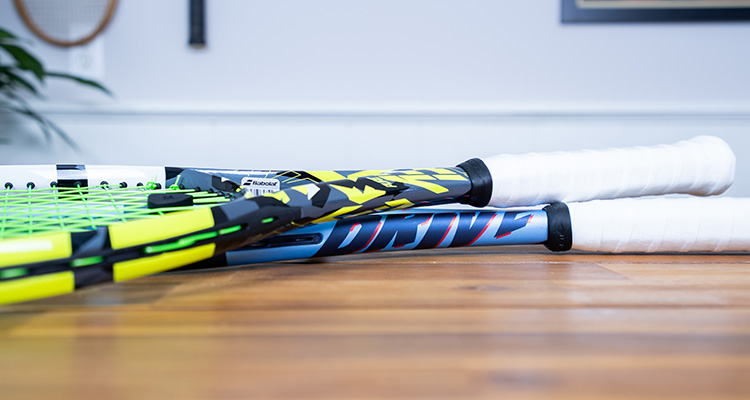
The Pure Aero and Pure Drive occupy the same general performance space as modern tweener frames, but they arrive there through different means. Both offer easy access to power in a familiar 100-square-inch platform, yet the way the racquets deliver that power on court feels meaningfully different once you spend time hitting with them side by side.
The Pure Drive leans toward a more direct style of play. It rewards players who like to take control early in points, generate depth without overexerting, and press from the baseline with a firm, assertive response. Its power shows up quickly and predictably, making it a strong option for players who prefer to drive through the court from the baseline.
The Pure Aero, by contrast, emphasizes shape, spin, and adaptability. Its whippier feel and slightly more measured response make it easier to manage power as swing speeds increase, while offering more flexibility in defensive and transitional situations. The differences aren’t dramatic, but they’re consistent, and over time, they can influence how you approach points and which patterns begin to feel more natural.
Over time, the distinction becomes less about raw power and more about whether you prefer to apply it through direct pace with the Pure Drive or added shape and margin with the Pure Aero. Both frames are accessible, but they tend to reward different habits as a player’s game develops.
Specs & Tech
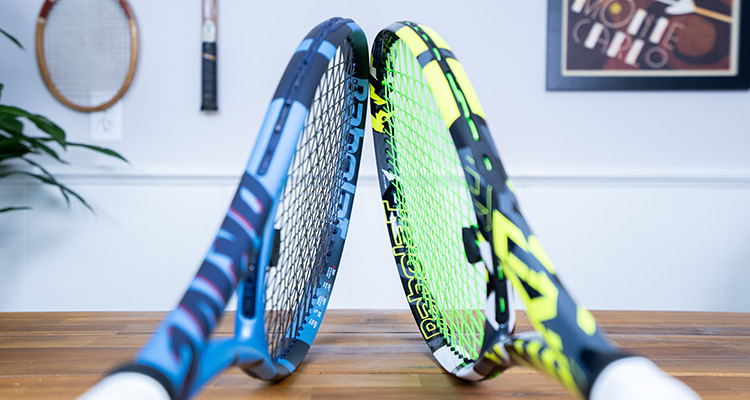
On paper, the Pure Aero and Pure Drive look very similar at a glance. Both feature a 100 in² head size, share the same strung weight and balance, and use a similar beam geometry. Even swingweight is effectively a wash. From a fitting standpoint, that puts them firmly in the same category and explains why they’re so often directly compared.
Where they begin to separate is stiffness and how the layup is tuned around that shared platform. The Pure Drive comes in a bit firmer, and that difference shows up less as harshness and more as immediacy. The frame returns energy quickly, which helps explain the easy depth and more direct response noted on court. The Pure Aero, while still objectively stiff, feels slightly more controlled by comparison, allowing the stringbed to stay engaged a touch longer and making it easier to access spin.
Both racquets use the same variable beam dimensions, but they don’t behave the same because construction, stiffness, and underlying tech dictate how that beam responds at impact. In the Pure Drive, the frame’s FSI Power technology, paired with Babolat’s HTR System that reinforces stiffness in the hoop, favors depth and penetration through the court. In the Pure Aero, its FSI Spin technology and Aero Modular design support more spin through faster vertical acceleration, aligning with its spin-oriented performance without sacrificing stability.
String pattern details also play a role. While both frames use a 16×19 pattern, the Pure Aero’s pattern has been tightened slightly compared to earlier generations. That change contributes to a more controlled response through the center of the stringbed, especially at higher swing speeds. Importantly, spin production doesn’t really suffer, as the frame still accelerates quickly and encourages a vertical swing path. The Pure Drive’s pattern, by contrast, feels livelier across more of the face, supporting depth and forgiveness on off-center contact.
Taken together, the specs reinforce what shows up on court. These racquets are built on a similar foundation, but tuned with different priorities. The Pure Drive emphasizes a quicker energy return, while the Pure Aero balances power with added dwell time and spin potential. The result isn’t a dramatic split on paper, but a consistent difference in how each frame delivers its performance once you start hitting.
| Specification | Pure Aero 2023 | Pure Drive 2025 |
| Head Size | 100 in² / 645.2 cm² | 100 in² / 645.2 cm² |
| Length | 27 in / 68.6 cm | 27 in / 68.6 cm |
| Strung Weight | 11.2oz / 318g | 11.2 oz / 318g |
| Balance | 33 cm / 4 pts HL | 33 cm / 4 pts HL |
| Swingweight | 318 | 317 |
| Stiffness | 66 | 69 |
| Beam Width | 23 mm / 26 mm / 23 mm | 23 mm / 26 mm / 23 mm |
| String Pattern | 16×19 | 16×19 |
Strings & Tension

For this comparison, I strung both the Pure Aero and Pure Drive with Babolat RPM Blast at 52 lbs (approximately 23.5 kg).
While Babolat lists slightly different recommended tension ranges for each frame, 52 lbs falls comfortably within both, making it a practical middle-ground reference point. Using the same string and tension in both racquets also made it easier to isolate differences in frame response rather than attributing changes to the setup.
RPM Blast is a natural fit for both racquets, particularly given their shared emphasis on power and spin. In the Pure Drive, the string helped rein in some of the frame’s easy depth, adding a bit more predictability on fuller swings while preserving its naturally lively response. The setup felt stable and controlled when pressing from the baseline, especially during higher-tempo exchanges.
In the Pure Aero, RPM Blast paired cleanly with the frame’s faster acceleration and spin-friendly design. The slightly tighter string pattern in the latest Aero helped keep the response controlled at higher swing speeds, while RPM Blast still allowed the racquet to generate plenty of spin without feeling overly lively. At this tension, the setup felt balanced and stable, particularly when hitting with heavy topspin.
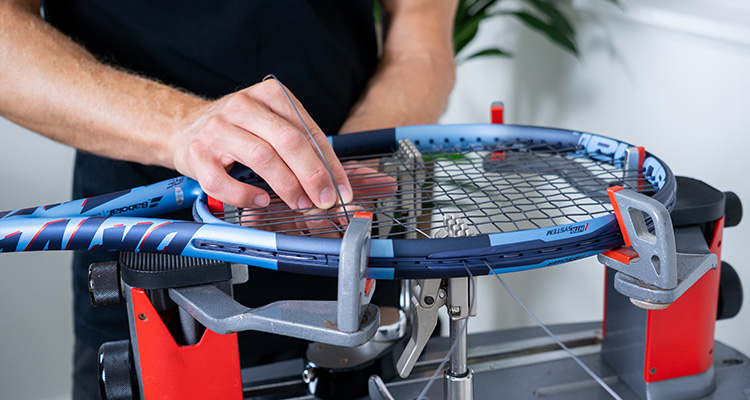
Players considering either frame should view this setup as a solid baseline rather than a universal recommendation. Those looking for more comfort or pocketing could experiment with dropping tension a few pounds or moving to a softer co-poly, while players who like to swing out may prefer to nudge tension up slightly for added control.
A hybrid setup can also make sense for players looking to soften the response without giving up too much spin. Running a polyester string in the mains with a softer cross—such as natural gut or a multifilament—can help maintain the spin-friendly characteristics of both frames while reducing shock and improving feel on off-center contact.
Synthetic gut wouldn’t be my first choice for either racquet. Still, it remains a viable, budget-friendly option for players seeking a straightforward, all-around setup without the firmness of poly.
Home > Gear > Racquets > Reviews > Babolat Pure Aero vs Pure Drive


Leave a Reply
Want to join the discussion?Feel free to contribute!